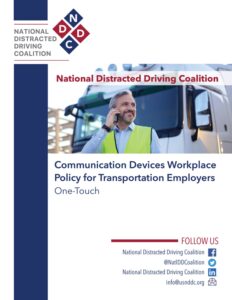
Distracted Driving Policies for Today’s Technology Environment
By Brenna Lyles, Senior Director, Safety Policy, ATA & Kevin Grove, Director, Safety & Technology Policy, ATA
The devices in our hands and in our vehicles have evolved dramatically in the past decade, as have the ways we use them. Modern touchscreen wireless devices, the proliferation of mobile applications, streaming video content at our fingertips, and wearables that send endless alerts have presented even more pervasive and persistent distractions for modern motorists.

Over the past two decades, state laws and federal policy have focused on straightforward restrictions when it comes to reducing behind-the-wheel distractions such as banning texting while driving, banning hand-held phone conversations, or restricting phone interactions to a one touch policy. Those rules were an important step toward improving roadway safety, but they reflected the technologies of a previous era. Today’s driving and technology landscapes look very different.
It’s no longer enough to define driving safety by performing – or ceasing – a specific phone-related task. More comprehensive approaches to distracted driving are needed, and they must encourage safer choices among all motorists. More importantly, these approaches must recognize both the risks and realities of technology while behind the wheel.
The trucking industry, with its broad experience with both Federally regulated policies for truck drivers as well as the widespread adoption of company safety policies, is prepared to lead the charge in promoting safe driving habits and reducing distractions behind the wheel.
Last month, the American Trucking Associations’ membership passed an updated policy on distracted driving that provides a strong foundation for this shift. Under this new policy, ATA recognizes that “activities that substantially divert a driver’s attention can endanger those who share the road.” The policy also recognizes that effective and consistent enforcement is key to changing the behavior of drivers and making sure they understand the risks of these behaviors. In addition, it calls for uniform federal and state laws that apply not only to commercial drivers, but to all motorists – a crucial step toward fairness, clarity, and enforceability.
Rethinking Distraction
Too often, distracted driving laws are written around a single device or action, like no texting, no handheld phones, or no video watching. While well-intentioned, these piecemeal approaches struggle to keep pace with innovation and the multi-faceted nature of distraction. The next generation of safety and distracted driving-related policy must focus on the core principle of attention management: anything that materially diverts a driver’s eyes, hands, or mind from the task of driving should be minimized as much as reasonably possible.

That’s why ATA’s newly updated policy emphasizes that laws should “clearly define inappropriate handheld and other device use” – including texting, web browsing, gaming, and video calls – while preserving reasonable exemptions for safety and practicality. This framework creates space for hands-free, safety-enhancing technologies and avoids penalizing responsible use of tools that make professional drivers safer and more efficient.
Leveraging Technology for Safer Roads

Technology isn’t just part of the problem. It’s also part of the solution. Advanced driver-assistance systems (ADAS), camera-based monitoring, and fleet telematics can help identify risky behaviors before they lead to crashes. Real-time alerts, driver coaching apps, and fleet safety analytics can leverage potential moments of distraction into opportunities for improvement and crash mitigation. By encouraging technology that supports attention rather than divides it, the trucking industry can lead a cultural shift for all motorists to learn and act whenever there is a loss of focus.
A Shared Responsibility
Distracted driving isn’t just a problem for the trucking industry. The responsibility of reducing distracted driving on our roadways and preventing fatal crashes falls on all motorists. ATA’s call for uniform distracted driving laws across both passenger and commercial vehicles is about creating a level playing field and a consistent message: every driver has a role to play in keeping our roads safe.
As the nation’s highways become more connected and more complex, attitudes about device use must shift, and we need rules that also keep pace. It’s time to recognize the breadth of distracting behaviors and build a comprehensive, adaptable distracted driving strategy that reflects today’s technology, roads, and realities.
The trucking industry is ready to lead that change.
NDDC Steering Committee Press Contacts
Nick Chabarria
Automobile Club Of Missouri


JOE YOUNG
Insurance Institute for Highway Safety